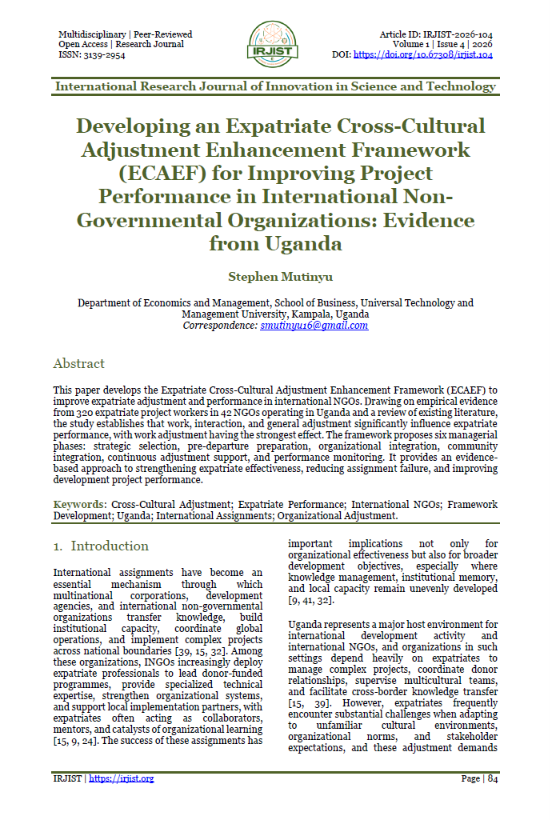
Developing an Expatriate Cross-Cultural Adjustment Enhancement Framework (ECAEF) for Improving Project Performance in International Non-Governmental Organizations: Evidence from Uganda
DOI:
https://doi.org/10.67308/irjist.104Keywords:
Cross-Cultural Adjustment, Expatriate Performance, International NGOs, Framework Development, Uganda, International Assignments, Organizational AdjustmentAbstract
This paper develops the Expatriate Cross-Cultural Adjustment Enhancement Framework (ECAEF) to improve expatriate adjustment and performance in international NGOs. Drawing on empirical evidence from 320 expatriate project workers in 42 NGOs operating in Uganda and a review of existing literature, the study establishes that work, interaction, and general adjustment significantly influence expatriate performance, with work adjustment having the strongest effect. The framework proposes six managerial phases: strategic selection, pre-departure preparation, organizational integration, community integration, continuous adjustment support, and performance monitoring. It provides an evidence-based approach to strengthening expatriate effectiveness, reducing assignment failure, and improving development project performance.
Downloads
References
[1] Abdalla, A., Li, X., & Yang, F. (2024). Expatriate construction professionals' performance in international construction projects: The role of cross-cultural adjustment and job burnout. Journal of Construction Engineering and Management, 150(3), Article 04024003.
DOI:https://doi.org/10.1061/JCEMD4.COENG-13912
[2] Andersen, N. (2021). Mapping the expatriate literature: A bibliometric review of the field from 1998 to 2017 and identification of current research fronts. The International Journal of Human Resource Management, 32(22), 4687–4724.
DOI:https://doi.org/10.1080/09585192.2019.1661267
[3] Armon, B., Steelman, L. A., & Jensen, S. (2023). The role of the feedback environment in expatriate adjustment. Journal of Global Mobility, 11(2), 200–214.
DOI:https://doi.org/10.1108/JGM-08-2022-0040
[4] Bano, N., & Liu, Y. (2025). Cross cultural adaptation challenges: A study on Chinese expatriates in Muslim countries along Belt and Road. International Journal of Cross Cultural Management. Advance online publication.
[5] Benton, A. (2016). African expatriates and race in the anthropology of humanitarianism. Critical African Studies, 8(3), 266–277.
DOI:https://doi.org/10.1080/21681392.2016.1244956
[6] Bhaskar-Shrinivas, P., Harrison, D. A., Shaffer, M. A., & Luk, D. M. (2005). Input-based and time-based models of international adjustment: Meta-analytic evidence and theoretical extensions. Academy of Management Journal, 48(2), 257–281.
DOI:https://doi.org/10.5465/AMJ.2005.16928400
[7] Black, J. S., & Mendenhall, M. (1991). The U-curve adjustment hypothesis revisited: A review and theoretical framework. Journal of International Business Studies, 22(2), 225–247.
[8] Black, J. S., Mendenhall, M., & Oddou, G. (1991). Toward a comprehensive model of international adjustment: An integration of multiple theoretical perspectives. Academy of Management Review, 16(2), 291–317.
DOI:https://doi.org/10.5465/AMR.1991.4278938
[9] Caballero-Anthony, M., Cook, A. D. B., & Chen, C. (2021). Knowledge management and humanitarian organisations in the Asia-Pacific: Practices, challenges, and future pathways. International Journal of Disaster Risk Reduction, 51, 101834.
[10] Caldwell, H., Donnelly, R., & Yang, H. (2024). Reviewing and revising Black et al.'s adjustment model(s). The International Journal of Human Resource Management, 35(6), 932–963.
DOI:https://doi.org/10.1080/09585192.2023.2297827
[11] Chan, H. T., Zawawi, D., Ng, S. I., & Nipo, D. T. (2021). No expatriate is an island: The role of salient stakeholders' support in international assignments. International Journal of Manpower, 42(7), 1108–1127.
DOI:https://doi.org/10.1108/IJM-11-2019-0520
[12] Chen, M. (2019). The impact of expatriates' cross-cultural adjustment on work stress and job involvement in the high-tech industry. Frontiers in Psychology, 10, Article 2228.
DOI:https://doi.org/10.3389/fpsyg.2019.02228
[13] Davies, S., Stoermer, S., & Froese, F. J. (2019). When the going gets tough: The influence of expatriate resilience and perceived organizational inclusion climate on work adjustment and turnover intentions. The International Journal of Human Resource Management, 30(8), 1393–1417.
DOI:https://doi.org/10.1080/09585192.2018.1528558
[14] Ererdi, C., Nurgabdeshov, A., Kozhakhmet, S., Rofcanin, Y., & Demirbağ, M. (2021). International HRM in the context of uncertainty and crisis: A systematic review of literature (2000–2018). The International Journal of Human Resource Management, 32(12), 2547–2576.
[15] Fee, A., & Gray, S. (2020). Expatriates as catalysts: What and how Vietnamese locals learn from self-initiated expatriates. Cross Cultural & Strategic Management, 27(3), 435–458.
[16] Fee, A., & Michailova, S. (2020). How host organizations prepare for and learn from expatriate assignments. Thunderbird International Business Review, 62(4), 461–475.
[17] Giorgi, G., Lecca, L. I., Ariza-Montes, A., Di Massimo, C., Campagna, M., Finstad, G. L., Arcangeli, G., & Mucci, N. (2020). The dark and the light side of the expatriate's cross-cultural adjustment: A novel framework including perceived organizational support, work-related stress and innovation. Sustainability, 12(7), Article 2969.
DOI:https://doi.org/10.3390/su12072969
[18] Guo, Y., Rammal, H. G., & Pereira, V. (2021). Am I "in or out"? A social identity approach to studying expatriates' social networks and adjustment in a host country context. Journal of Business Research, 136, 558–566.
DOI:https://doi.org/10.1016/j.jbusres.2021.07.059
[19] Han, Y., Sears, G. J., Darr, W. A., & Wang, Y. (2022). Facilitating cross-cultural adaptation: A meta-analytic review of dispositional predictors of expatriate adjustment. Journal of Cross-Cultural Psychology, 53(9), 1054–1096.
DOI:https://doi.org/10.1177/00220221221109559
[20] Harari, M. B., Reaves, A. C., Beane, D., Laginess, A. J., & Viswesvaran, C. (2018). Personality and expatriate adjustment: A meta-analysis. Journal of Occupational and Organizational Psychology, 91(3), 486–517.
DOI:https://doi.org/10.1111/joop.12215
[21] Iheanachor, N., Costa-Climent, R., Ulrich, K., & Ozegbe, E. (2024). Cross-cultural training and expatriate adjustment: An assessment of expatriates on assignment in African countries. Management Decision. Advance online publication.
DOI:https://doi.org/10.1108/MD-06-2023-0985
[22] Jabareen, Y. (2009). Building a conceptual framework: Philosophy, definitions, and procedure. International Journal of Qualitative Methods, 8(4), 49–62.
DOI:https://doi.org/10.1177/160940690900800406
[23] Kiti, K., Wang, G., Arku, J. K., Ankrah, S. T., & Aliyu, D. M. (2024). Strategic implementation of social support for expatriate management in Thailand's hospitality sector. Sustainability, 16(23), Article 10639.
DOI:https://doi.org/10.3390/su162310639
[24] Lazarova, M., Dimitrova, M., Dickmann, M., Brewster, C., & Cerdin, J. L. (2021). Career satisfaction of expatriates in humanitarian inter-governmental organizations. Journal of World Business, 56(4), Article 101205.
DOI:https://doi.org/10.1016/j.jwb.2021.101205
[25] Li, X., & Al-Haimi, B. (2025). Toward a glocalized model of expatriate adjustment: Evidence from Chinese expatriates in Africa. International Journal of Academic Research in Economics and Management Sciences, 14(3).
DOI:https://doi.org/10.6007/IJAREMS/v14-i3/26410
[26] Liao, Y. K., Wu, W. Y., Dao, T. C., & Luu, T. M. N. (2021). The influence of emotional intelligence and cultural adaptability on cross-cultural adjustment and performance with the mediating effect of cross-cultural competence: A study of expatriates in Taiwan. Sustainability, 13(6), Article 3374.
DOI:https://doi.org/10.3390/su13063374
[27] Lo, F. Y., & Nguyen, T. H. N. (2023). Cross-cultural adjustment and training on international expatriates' performance. Technological Forecasting and Social Change, 194, Article 122294.
DOI:https://doi.org/10.1016/j.techfore.2022.122294
[28] Ma, Y. (2022). International organizations and expatriates: Implications for supporting the successful cultural adjustment. Frontiers in Management Science, 1(3), 37–43.
DOI:https://doi.org/10.56397/FMS.2022.12.04
[29] Mukasa, S. (1999). Are expatriate staff necessary in international development NGOs? A case study of an international NGO in Uganda. LSE Research Online, London School of Economics and Political Science.
[30] Mutinyu, S., & Tukei, J. M. O. (2026). Cross-cultural adjustment and performance of expatriate NGO project workers in Uganda. JENER Journal of Empirical and Non-Empirical Research, 2(10), 1786–1797.
[31] Noman, M., Sial, M. S., Samad, S., Li, R., & Shi, M. (2023). Adjustment of self-initiated and organizational expatriates: The moderating role of cross-cultural training. Frontiers in Psychology, 13, Article 1044040.
DOI:https://doi.org/10.3389/fpsyg.2022.1044040
[32] Oleškevičiūtė, E., Dickmann, M., Andresen, M., & Parry, E. (2022). The international transfer of individual career capital: Exploring and developing a model of the underlying factors. Journal of Global Mobility, 10(4), 397–417.
[33] Richey, R. C., & Klein, J. D. (2014). Design and development research. In J. M. Spector, M. D. Merrill, J. Elen, & M. J. Bishop (Eds.), Handbook of research on educational communications and technology (4th ed., pp. 141–150). Springer.
DOI:https://doi.org/10.1007/978-1-4614-3185-5_12
[34] Ritchie, W. J., Brantley, B. I., Pattie, M. W., Swanson, B., & Logsdon, J. M. (2015). Expatriate cultural antecedents and outcomes: An assessment tool for nonprofit managers. Nonprofit Management and Leadership, 25(3), 325–342.
DOI:https://doi.org/10.1002/nml.21128
[35] Setiawan, F. A., Churiyah, M., & Zagladi, A. N. (2024). Cross cultural adjustment on expatriate: Systematic literature review. Jurnal Manajemen Diversifikasi, 4(4).
DOI:https://doi.org/10.24127/diversifikasi.v4i4.5789
[36] Setti, I., Sommovigo, V., & Argentero, P. (2020). Enhancing expatriates' assignments success: The relationships between cultural intelligence, cross-cultural adaptation and performance. Current Psychology, 41(7), 4291–4311.
DOI:https://doi.org/10.1007/s12144-020-00931-w
[37] Sokro, E., Pillay, S., & Bednall, T. (2021). The effects of perceived organizational support on expatriate adjustment, assignment completion and job satisfaction. International Journal of Cross Cultural Management, 21(3), 452–473.
DOI:https://doi.org/10.1177/14705958211061007
[38] Sousa, C., Gonçalves, G., Santos, J., & Leitão, J. (2017). Organizational practices for the expatriates' adjustment: A systematic review. Journal of Global Mobility, 6(3/4), 251–274.
DOI:https://doi.org/10.1108/JGM-03-2017-0011
[39] Stoermer, S., Davies, S., & Froese, F. J. (2020). The influence of expatriate cultural intelligence on organizational embeddedness and knowledge sharing: The moderating effects of host country context. Journal of International Business Studies, 51(3), 432–453.
[40] Strubler, D. C., Park, S. H., & Agarwal, A. (2011). Revisiting Black, Mendenhall, and Oddou's framework for international adjustment model: A prescriptive approach. Journal of International Business Research, 10(1), 103–128.
[41] Wang, M., Wei, Y., Azumah, G., & Wang, C. L. (2023). African returnees in international knowledge transfer: A social capital perspective. Journal of International Management, 29(4), 101051.
Downloads
Published
Issue
Section
License
Copyright (c) 2026 Stephen Mutinyu (Author)

This work is licensed under a Creative Commons Attribution 4.0 International License.
Articles published in the International Research Journal of Innovation in Science and Technology (IRJIST) are licensed under the Creative Commons Attribution 4.0 International License (CC BY 4.0).
This license permits unrestricted use, distribution, and reproduction in any medium, provided the original work is properly cited.
Authors retain the copyright of their work and grant the journal the right of first publication. Proper attribution to the authors and the journal is required for any reuse of the published content.
 IRJIST on WhatsApp
 IRJIST on Instagram