An Integrated Lean Six Sigma Framework for Waste Reduction and Resource Efficiency in Manufacturing
DOI:
https://doi.org/10.67308/irjist.043Keywords:
Lean Manufacturing, Six Sigma, Resource Efficiency, Waste Reduction, Process Optimization, DMAIC, Sustainable Manufacturing, Continuous ImprovementAbstract
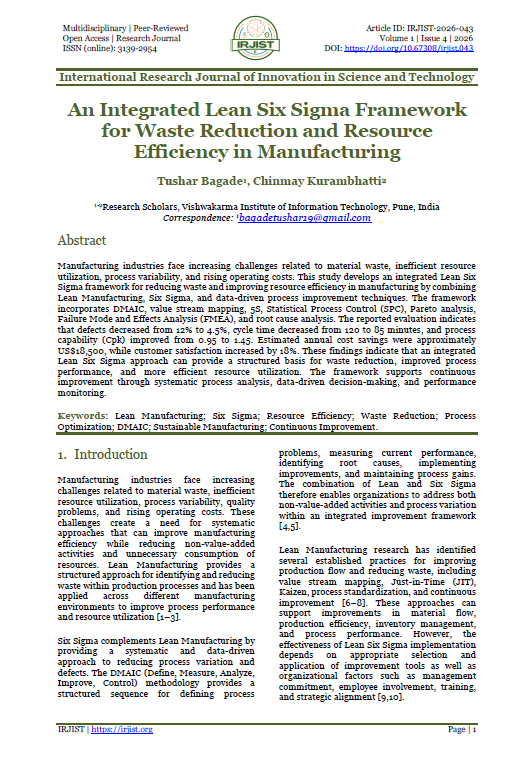
Manufacturing industries face increasing challenges related to material waste, inefficient resource utilization, process variability, and rising operating costs. This study develops an integrated Lean Six Sigma framework for reducing waste and improving resource efficiency in manufacturing by combining Lean Manufacturing, Six Sigma, and data-driven process improvement techniques. The framework incorporates DMAIC, value stream mapping, 5S, Statistical Process Control (SPC), Pareto analysis, Failure Mode and Effects Analysis (FMEA), and root cause analysis. The reported evaluation indicates that defects decreased from 12% to 4.5%, cycle time decreased from 120 to 85 minutes, and process capability (Cpk) improved from 0.95 to 1.45. Estimated annual cost savings were approximately US$18,500, while customer satisfaction increased by 18%. These findings indicate that an integrated Lean Six Sigma approach can provide a structured basis for waste reduction, improved process performance, and more efficient resource utilization. The framework supports continuous improvement through systematic process analysis, data-driven decision-making, and performance monitoring.
Downloads
References
[1] Rahmanasari D, Sutopo W, Rohani JM. Implementation of lean manufacturing process to reduce waste: a case study. IOP Conf Ser Mater Sci Eng. 2021;1096(1):012006. doi:10.1088/1757-899X/1096/1/012006.
[2] Clancy R, O'Sullivan D, Bruton K. Data-driven quality improvement approach to reducing waste in manufacturing. TQM J. 2023;35(1):51-72. doi:10.1108/TQM-02-2021-0061.
[3] Kaneku-Orbegozo J, Martinez-Palomino J, Sotelo-Raffo F, Ramos-Palomino E. Applying lean manufacturing principles to reduce waste and improve process in a manufacturer: a research study in Peru. IOP Conf Ser Mater Sci Eng. 2019;689(1):012020.
[4] Hassan MK. Applying Lean Six Sigma for waste reduction in a manufacturing environment. Am J Ind Eng. 2013;1(2):28-35. doi:10.12691/ajie-1-2-4.
[5] Albliwi S, Antony J, Lim SAH. A systematic review of Lean Six Sigma for the manufacturing industry. Bus Process Manag J. 2015;21(3):665-691. doi:10.1108/BPMJ-03-2014-0019.
[6] Bhamu J, Sangwan KS. Lean manufacturing: literature review and research issues. Int J Oper Prod Manag. 2014;34(7):876-940. doi:10.1108/IJOPM-08-2012-0315.
[7] Cuggia-Jiménez C, Orozco-Acosta E, Mendoza-Galvis D. Manufactura esbelta: una revisión sistemática en la industria de alimentos. Inf Tecnol. 2020;31(5):163-172. doi:10.4067/S0718-07642020000500163.
[8] Pinto JLQ, Matias JCO, Pimentel C, Azevedo SG, Govindan K. Lean manufacturing and Kaizen. In: Just in Time Factory: Implementation through Lean Manufacturing Tools. 2018. p.5-24. doi:10.1007/978-3-319-77016-1_2.
[9] Alaa AS, Shaiful AIM, Zain ZM, Malek AK. Impact of sustainable lean manufacturing (LM) on organizational performances. AIP Conf Proc. 2018;2030:020060. doi:10.1063/1.5066701.
[10] Larsen DW. Analysis of the impact of lean manufacturing tools on efficiency [dissertation]. University of Wisconsin-Stout; 2020.
[11] Blume S, Herrmann C, Thiede S. Increasing resource efficiency of manufacturing systems using a knowledge-based system. Procedia CIRP. 2018;69:236-241. doi:10.1016/j.procir.2017.11.126.
[12] George ML, Rowlands DT, Kastle B. What Is Lean Six Sigma? New York: McGraw-Hill Professional; 2005.
[13] Chaudhari KS, More NB, Somatkar A. Risk assessment in automated manufacturing systems: a hybrid framework for Industry 4.0 and beyond. Int Res J Innov Sci Technol. 2026;1(2):54-63.
[14] Stankalla R, Koval O, Chromjakova F. A review of critical success factors for the successful implementation of Lean Six Sigma and Six Sigma in manufacturing small and medium sized enterprises. Qual Eng. 2018;30(3):453-468.
[15] Bhaskar HL. Lean six sigma in manufacturing: a comprehensive review. In: Lean Manufacturing and Six Sigma—Behind the Mask. 2020, doi:10.5772/intechopen.89859
[16] Sordan JE, Oprime PC, Pimenta ML, Chiabert P, Lombardi F. Lean Six Sigma in manufacturing process: a bibliometric study and research agenda. TQM J. 2020;32(3):381-399. doi:10.1108/TQM-08-2019-0207.
[17] Alexander P, Antony J, Rodgers B. Lean Six Sigma for small- and medium-sized manufacturing enterprises: a systematic review. Int J Qual Reliab Manag. 2019;36(3):378-397. doi:10.1108/IJQRM-03-2018-0074.
[18] Swarnakar V, Vinodh S. Deploying Lean Six Sigma framework in an automotive component manufacturing organization. Int J Lean Six Sigma. 2016;7(3):267-293. doi:10.1108/IJLSS-06-2015-0023.
[19] Antony J, Gijo EV, Childe SJ. Case study in Six Sigma methodology: manufacturing quality improvement and guidance for managers. Prod Plan Control. 2012;23(8):624-640. doi:10.1080/09537287.2011.576404.
[20] Valles A, Sanchez J, Noriega S, Nuñez BG. Implementation of Six Sigma in a manufacturing process: a case study. Int J Ind Eng Theory Appl Pract. 2009;16(3):171-181. doi:10.23055/ijietap.2009.16.3.263.
Downloads
Published
Issue
Section
License
Copyright (c) 2026 Tushar Bagade, Chinmay Kurambhatti (Author)

This work is licensed under a Creative Commons Attribution 4.0 International License.
Articles published in the International Research Journal of Innovation in Science and Technology (IRJIST) are licensed under the Creative Commons Attribution 4.0 International License (CC BY 4.0).
This license permits unrestricted use, distribution, and reproduction in any medium, provided the original work is properly cited.
Authors retain the copyright of their work and grant the journal the right of first publication. Proper attribution to the authors and the journal is required for any reuse of the published content.